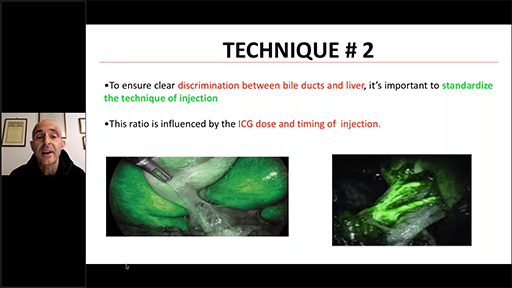
Fluorescence-Guided Procedure in Pediatrics

  • Thumbnail 512x288:
  • Título del video: Fluorescence-Guided Procedure in Pediatrics
  • Speakers: Silvana Prodan, MD
  • Descripción: This video demonstrates the use of indocyanine green (ICG) fluorescence imaging to enhance intraoperative visualization. The technique supports real-time identification of anatomical structures and tissue perfusion, improving precision and surgical decision-making.
  • Youtube/Vimeo link: https://youtu.be/LMUV7guLBXM

EMEA ICG Dosing for Cholecystectomy (Paediatric)

  • Intro:

    Indocyanine green (ICG) fluorescence imaging is increasingly used in paediatric cholecystectomy to enhance visualization of biliary anatomy and support safe dissection. By enabling real-time identification of the cystic duct and common bile duct, this technique improves anatomical orientation and reduces the risk of bile duct injury.

    Clinical evidence suggests that ICG fluorescence cholangiography is safe, feasible, and may represent a new standard in paediatric laparoscopic cholecystectomy, offering better visualization, shorter operative time, and fewer complications compared to conventional techniques.

    In the EMEA region, standardized dosing and timing protocols help ensure consistent fluorescence imaging and optimize surgical outcomes in paediatric patients.

  • Sección:
    • Tabla:
      • Columna1:

        Region of interest

        , Contenido:

        Bile Ducts

      • Columna1:

        Dose

        , Contenido:

        0.4 mg/kg

      • Columna1:

        Route

        , Contenido:

        I.V.*

      • Columna1:

        Injection time

        , Contenido:

        18 hr before surgery

      • Columna1:

        First ICG detection

        , Contenido:

        Beginning of surgery

      • Columna1:

        ICG Duration

        , Contenido:

        Remains visible during procedure

      • Columna1:

        Camera requirements

        , Contenido:

        Laparoscope, NIR light source camera

      • Columna1:

        References  (full ref details at end of this guide doc)

        , Contenido:

        11. 2019, Esposito et al.,

ICG Dosing and Timing for Pediatric Fluorescence-Guided Surgery

  • Intro:

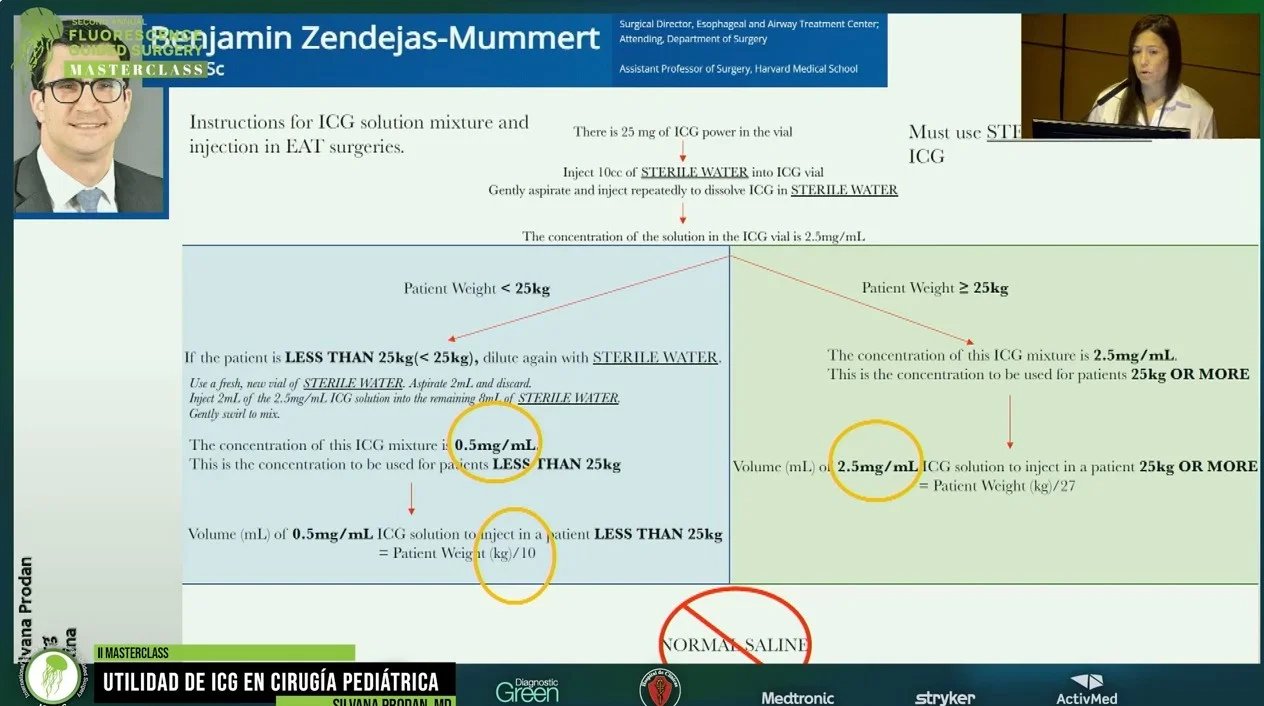
    Indocyanine green (ICG) fluorescence imaging is increasingly used in pediatric surgery to visualize anatomy, assess tissue perfusion, and guide intraoperative decision-making. When combined with near-infrared imaging systems, ICG allows surgeons to evaluate blood flow, identify lymphatic pathways, and improve anatomical visualization during a wide range of pediatric procedures.

    This pediatric dosing chart provides guidance on recommended ICG administration in children, including weight-based dosing, dilution protocols, injection techniques, and timing of administration for different surgical applications such as perfusion assessment, biliary visualization, tumor detection, and sentinel lymph node mapping.

  • Sección:
    • Title: Angiography & Perfusion Assessment, Contenido:

      Skin and soft tissue
      Intestinal perfusion
      Organ ischemia

      , Tabla:
      • Columna1:

        Purpose:

        , Contenido:

        Visualize blood flow to area of interest

      • Columna1:

        Injection Type: 

        , Contenido:

        #Intravenous

      • Columna1:

        Typical dilution:

        , Contenido:

        <25 kg: 0.5 mg/ml
        >25 kg: 2.5 mg/ml

      • Columna1:

        Usual dosage (amount):

        , Contenido:

        <25 kg: 0.1 mg/kg
        >25 kg: 5 mg (2 ml)

      • Columna1:

        Real time, as desired

      • Columna1:

        First ICG detection

        , Contenido:

        Within seconds

      • Columna1:

        ICG duration:

        , Contenido:

        Minutes

      • Columna1:

        Notes:

        , Contenido:

        Speed of uptake in first few seconds can be important. Can be redosed if needed.

    • Title: Extrahepatic Biliary Tree, Contenido:

      Cholecystectomy
      Choledochal cyst
      Portoenterostomy

      , Tabla:
      • Columna1:

        Purpose:

        , Contenido:

        Bile duct identification

      • Columna1:

        Injection type

        , Contenido:

        #Intravenous

      • Columna1:

        Typical dilution

        , Contenido:

        <25 kg: 0.5 mg/ml
        >25 kg: 2.5 mg/ml

      • Columna1:

        Usual dosage (amount)

        , Contenido:

        <25 kg: 0.1 mg/kg
        >25 kg: 5 mg (2 ml)

      • Columna1:

        Injection time

        , Contenido:

        Between 45 minutes and 2 hours prior to induction

      • Columna1:

        First ICG detection

        , Contenido:

        With exposure of hepatocystic triangle

      • Columna1:

        ICG duration

        , Contenido:

        Hours

      • Columna1:

        Notes

        , Contenido:

        Time in advance decreases liver background signal to allow focus on ducts.

    • Title: Liver Tumor , Contenido:

      Hepatoblastoma

      , Tabla:
      • Columna1:

        Purpose

        , Contenido:

        Tumor visualization and margin assessment

      • Columna1:

        Injection type

        , Contenido:

        #Intravenous

      • Columna1:

        Typical dilution

        , Contenido:

        2.5 mg/ml

      • Columna1:

        Usual dosage (amount)

        , Contenido:

        0.5 mg/kg

      • Columna1:

        Injection time

        , Contenido:

        72 to 96 hours prior to surgery

      • Columna1:

        First ICG detection

        , Contenido:

        As needed

      • Columna1:

        ICG duration

        , Contenido:

        Stable during surgery

      • Columna1:

        Notes

        , Contenido:

        Tumors remain fluorescent after normal liver has fully excreted the dye.

    • Title: Sarcomas & Other Tumors, Contenido:

      Ewing Sarcoma
      Osteosarcoma
      Rhabdomyosarcoma
      Sacrococcygeal Teratoma

      , Tabla:
      • Columna1:

        Purpose

        , Contenido:

        Tumor visualization and margin assessment

      • Columna1:

        Injection type

        , Contenido:

        #Intravenous

      • Columna1:

        Typical dilution

        , Contenido:

        2.5 mg/ml

      • Columna1:

        Usual dosage (amount)

        , Contenido:

        4 mg/kg

      • Columna1:

        Injection time

        , Contenido:

        24 hours prior to surgery

      • Columna1:

        First ICG detection

        , Contenido:

        As needed

      • Columna1:

        ICG duration

        , Contenido:

        Stable during surgery

      • Columna1:

        Notes

        , Contenido:

        Variable per tumor biology and pretreatment necrosis. Relies on enhanced permeability and retention effect.

    • Title: Pulmonary Metastasectomy, Contenido:

      Hepatoblastoma
      Wilms tumor
      Sarcomas

      , Tabla:
      • Columna1:

        Purpose

        , Contenido:

        Metastasis identification

      • Columna1:

        Injection type

        , Contenido:

        #Intravenous

      • Columna1:

        Typical dilution

        , Contenido:

        2.5 mg/ml

      • Columna1:

        Usual dosage (amount)

        , Contenido:

        0.5 mg/kg if liver primary; 4 mg/kg all others

      • Columna1:

        Injection time

        , Contenido:

        24 hours prior to surgery

      • Columna1:

        First ICG detection

        , Contenido:

        As needed

      • Columna1:

        ICG duration

        , Contenido:

        Stable during surgery

      • Columna1:

        Notes

        , Contenido:

        Can be missed if deeper than 1 cm in lung parenchyma.

    • Title: SLN Biopsy, Contenido:

      Melanoma
      Rhabdomyosarcoma

      , Tabla:
      • Columna1:

        Purpose

        , Contenido:

        Identification of SLN

      • Columna1:

        Injection type

        , Contenido:

        4-quadrant dermal (skin lesions) or subcutaneous (other tumors)

      • Columna1:

        Typical dilution

        , Contenido:

        1.25 mg/ml

      • Columna1:

        Usual dosage (amount)

        , Contenido:

        1.25 mg (1 ml) per quadrant

      • Columna1:

        Injection time

        , Contenido:

        At start of procedure

      • Columna1:

        First ICG detection

        , Contenido:

        5-10 minutes in expected nodal basin

      • Columna1:

        ICG duration

        , Contenido:

        Stable during surgery

      • Columna1:

        Notes

        , Contenido:

        Can be paired with radiotracer.

Dosing & Timing Chart Back Main Menu Read more ICG, indocyanine green; SLN, sentinel lymph node#All intravenous administrations should be followed by routine saline flush. This is particularly important if visualization is anticipated to be immediate.*2.5 mg/ml is standard dilution from lyophilized ICG. For 0.5 mg/ml, mix 2 ml standard dilution with 8 ml sterile water. For 1.25 mg/ml mix even parts...

Quirófano Abierto - Prodan

  • Thumbnail 512x288:
  • Título del video: Dra. Silvana Prodan
  • Chapter: LATAM CHAPTER
  • Speakers: Episodio 2
  • Moderators: Dra. Ana Carrasquilla
  • Descripción: Nuestro invitado especial en el segundo episodio es la Dra. Silvana Prodan que presenta dos casos pediátricos.
  • Youtube/Vimeo link: https://vimeo.com/1110288801?share=copy

La Importancia de ICG en la Identificación de Estructuras Anatómicas, Hernioplastia Laparoscópica Utilidad de ICG en Cirugía Pediátrica

  • Thumbnail 512x288:
  • Congreso: FGS Masterclass 2024
  • Título del video: La Importancia de ICG en la Identificación de Estructuras Anatómicas, Hernioplastia Laparoscópica Utilidad de ICG en Cirugía Pediátrica
  • Chapter: LATAM CHAPTER
  • Speakers: Hernán Todeschini
  • Youtube/Vimeo link: https://www.youtube.com/watch?v=8qNuNWYlbnw&t=1s
  • Date: 2024-04-04
La Importancia de ICG en la Identificación de Estructuras Anatómicas, Hernioplastia LaparoscópicaUtilidad de ICG en Cirugía Pediátrica

Experiencia en Cirugía Pediátrica con Verde Indocianina

  • Thumbnail 512x288:
  • Título del video: Experiencia en Cirugía Pediátrica con Verde Indocianina
  • Chapter: LATAM CHAPTER
  • Speakers: Carla Ramirez, Fernando González Arrechea, Héctor Santos Luna
  • Moderators: Juiio Aleman, Silvana Prodan
  • Youtube/Vimeo link: https://vimeo.com/937738684?share=copy
  • Date: 2024-04-17
Experiencia en Cirugía Pediátrica con Verde Indocianina Carla Ramirez Fernando González Arrechea Héctor Santos Luna Julio Aleman Silvana Prodan

Fluorescent Image Guided Pediatric Surgery

  • Thumbnail 512x288:
  • Título del video: Fluorescent Image Guided Pediatric Surgery
  • Speakers: Ciro Esposito
  • Descripción: Indocyanine green (ICG)-guided near-infrared fluorescence (NIRF) has been recently adopted in pediatric minimally invasive surgery (MIS). This video aimed to report our experience with ICG-guided NIRF in pediatric laparoscopy, thoracoscopy and robotics and evaluate its usefulness and technique of application in different pediatric pathologies.
  • Youtube/Vimeo link: https://www.youtube.com/watch?v=nnVNkjwFJKs&t=81s
  • Date: 2020-12-14
Fluorescent Image Guided Pediatric Surgery Ciro Esposito Indocyanine green (ICG)-guided near-infrared fluorescence (NIRF) has been recently adopted in pediatric minimally invasive surgery (MIS). This video aimed to report our experience with ICG-guided NIRF in pediatric laparoscopy, thoracoscopy and robotics and evaluate its usefulness and technique of application in different pediatric pathologies. 14-12-2020

Applications of Indocyanine Green-Guided Near-Infrared Fluorescence Imaging in Pediatric Minimally Invasive Surgery Urology: A Narrative Review

  • Título completo del paper: Applications of Indocyanine Green-Guided Near-Infrared Fluorescence Imaging in Pediatric Minimally Invasive Surgery Urology: A Narrative Review
  • Autores: Ciro Esposito, Rachele Borgogni, Giuseppe Autorino, Mariapina Cerulo, Roberto Carulli, Giovanni Esposito, Fulvia Del Conte, Maria Escolino
  • Fecha de publicacion: 2022-11-25
  • doi: https://pubmed.ncbi.nlm.nih.gov/36450121/

Image-Guided Pediatric Surgery Using Indocyanine Green (ICG) Fluorescence in Laparoscopic and Robotic Surgery

  • Título completo del paper: Image-Guided Pediatric Surgery Using Indocyanine Green (ICG) Fluorescence in Laparoscopic and Robotic Surgery
  • Autores: Ciro Esposito, Alessandro Settimi, Fulvia Del Conte, Mariapina Cerulo, Vincenzo Coppola, Alessandra Farina, Felice Crocetto, Elisabetta Ricciardi, Giovanni Esposito, and Maria Escolino
  • Fecha de publicacion: 2020-06-20
  • doi: https://www.ncbi.nlm.nih.gov/pmc/articles/PMC7311575/

Indocyanine green fluorescence angiography in pediatric intestinal resections: A first prospective mixed methods clinical trial

  • Título completo del paper: Indocyanine green fluorescence angiography in pediatric intestinal resections: A first prospective mixed methods clinical trial
  • Autores: Annie Le-Nguyen, Claude Julie Bourque, Maeve O'Neill Trudeau, Thierry Ducruet, Christophe Faure, Nelson Piché
  • Fecha de publicacion: 2022-10-22
  • doi: https://pubmed.ncbi.nlm.nih.gov/36357227/

Let it glow: Intraoperative visualization of pulmonary metastases using pafolacianine, a next-generation fluorescent agent, for young adults undergoing pulmonary metastasectomy

  • Título completo del paper: Let it glow: Intraoperative visualization of pulmonary metastases using pafolacianine, a next-generation fluorescent agent, for young adults undergoing pulmonary metastasectomy
  • Autores: Alison Lehane, Stephanie F Polites, Ashley Dodd, Seth D Goldstein, Timothy B Lautz
  • Fecha de publicacion: 2024-11-01
  • doi: https://pubmed.ncbi.nlm.nih.gov/39192706/

Clinical Consensus Statement on the Use of Indocyanine Green Fluorescence-guided Surgery in Pediatric Patients

  • Título completo del paper: Clinical Consensus Statement on the Use of Indocyanine Green Fluorescence-guided Surgery in Pediatric Patients
  • Autores: Philipp O. Szavay, Alex Bondoc, Ciro Esposito, Seth D. Goldstein, Marc Harms, Grzegorz Kowalewski, Timothy B. Lautz, Manuel Lopez, Max Pachl, Samir Pandya, Nelson Piché, Steven S. Rothenberg, Jetske Ruiterkamp, Stefan Scholz, Benjamin Zendejas, Rebecca M. Rentea

  • Fecha de publicacion: 2024-11-01
  • doi: https://doi.org/10.1016/j.jpedsurg.2024.07.042